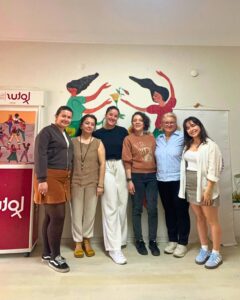
Founded in 2024 by scientists, journalists, sociologists, and activists, the Association for Communicating Social Good (Sosyal Fayda için İletişim Derneği – SoFI) works to strengthen the communication capacity of civil society organisations (CSOs) and promote rights-based communication in Türkiye. By providing tools, strategies, and expertise, SoFI helps CSOs tell their stories, increase their visibility, and engage wider audiences. Its work spans culture, arts, ecology, freedom of expression, anti-discrimination, and gender equality.
With our grant support, SoFI is implementing the New Media and Communication Capacities of Performing Artists project. This initiative equips independent performing artists and collectives with skills in social media content creation, digital advertising, AI tools, and crisis communication. Based on research with independent theatre stages in Istanbul, the project will train over 200 artists and establish a sustainable communication network to foster collaboration and knowledge-sharing.
Read the interview with SoFİ below, to learn more about the importance of rights-based communication, the visibility struggles of cultural and artistic actors, and the opportunities and risks emerging from digital transformation.
Change begins with the right communication.
SoFI was founded with the belief that social change is possible through effective communication. How would you introduce your organisation? Compared to other organisations working in this field, where do you position yourselves?
At SoFI, we see communication not just as the exchange of information, but as a reciprocal process of understanding and telling. This makes it a powerful tool for anyone seeking social transformation.
We put human rights, equality, and environmental rights at the centre of everything we do. Our rights-based approach aims to create an inclusive, accessible, and non-discriminatory language.
What sets us apart is that we do not carry out communication activities for others. Instead, we strengthen the capacity of individuals and institutions producing social good to do this themselves. We design projects that combine rights-based communication with new media and AI tools, supported by field research and reports, to create sustainable, needs-based solutions.
We need an approach to communication that transforms, not just functions.
In a country like Türkiye, where polarisation is often on the agenda, how can communication serve social good? As a young association, what have you observed in this area?
We need a transformative approach to communication — not just a functional one. Polarisation creates echo chambers, while algorithms trap us in narrow networks of “people like us.” The common challenge today is visibility. From CSOs to cultural producers, even those doing exceptional work struggle to shed their invisibility.
In the digital age, especially for those working for social good, using new technologies — including AI — with a rights-based approach is no longer optional, but essential. Given the state of mainstream media, the limited reach of alternative outlets, and the scale of disinformation on social media, there are few other ways to be seen.
Using new media tools strategically means sustainability.
What is your assessment of how civil society and cultural institutions approach communication?
Over the last 20 years, political dynamics and digital transformation have reshaped the communication field. While most media is now under the control of politically aligned capital, social media is dominated by algorithms and monopolisation pressures.
In this environment, few organisations use new media tools effectively. Yet, when used strategically, these tools provide not only visibility but also sustainability.
This is exactly what our project addresses. We have engaged with 95% of independent theatre stages in Istanbul and designed a training programme on communication strategy, digital tool use, and social media planning. Through in-person and online sessions, we aim to equip artists with lasting skills.
Our core strategy is to make a rights-based approach the backbone of communication practices.
How do you plan to advance your mission of promoting rights-based communication?
Rights-based communication has long been discussed in journalism and media. We believe it should also shape the language used by anyone producing social good. For us, it is not just an ethical guide — it is the backbone of communication practice.
We focus not only on how to use new media tools, but also on why and with what language. Our goal is to spread an inclusive and transformative approach that sees rights as interconnected and overlapping.
What benefits can correct and effective use of new media tools bring to cultural and artistic actors? What can be done to raise awareness and knowledge in this area?
Strategic use of new media allows artists not only to be visible, but to sustain their work. It helps them connect with audiences, build institutional memory, develop collaborations, and remain resilient in times of crisis. Without a conscious approach, however, these tools can deepen existing challenges.
Our project — supported by Türkiye Mozaik Foundation and the Support Foundation for Civil Society — brings together a founding team of experts with long-standing experience in the arts, especially independent theatre, alongside specialists in new media and AI.
Our research has confirmed many of our observations. For example, ticket sales platforms often weaken the direct link between theatres and their audiences. Many theatres have abandoned their websites, relying almost entirely on Instagram, which has become an obligatory — yet fragile — channel. Algorithm changes, platform closures, or shifts in the national agenda can have immediate effects on ticket sales.
Some theatre professionals say, “We don’t have a communication crisis,” but in reality, they face a recurring and poorly managed cycle of crises. Without a clear strategy, institutional resilience weakens over time, making the struggle to “stay alive” constant.
This project is the first step towards building more sustainable and strategic communication practices for the future.
Can you tell us about the activities and the expected impact of the project you are carrying out with our support?
Our aim is to respond to the communication needs of cultural actors with field-based data and to develop practices that provide lasting skills. This project is not just about meeting today’s needs, it’s about laying the foundation for more sustainable, strategic communication in the future.
We conducted semi-structured interviews with 95% of independent stages in Istanbul, which formed the basis for our training programme. The curriculum was shaped with input from academics in the arts and communication, as well as digital agencies. One of the most urgent needs identified was for clear communication strategies.
We also found that many theatres view social media as a creative space, but are unsure where to start. The mindset of “we are artists, this is not our field” is slowly shifting towards strategic thinking.
Our two-day in-person training and six online webinars will be more than just knowledge-sharing — they will create a space for collective thinking, experience exchange, and solidarity. In parallel, our field research will provide an up-to-date, evidence-based picture of communication practices in the cultural sector. The report will be shared publicly soon.