Our grantee partner, the Association for Justice and Rights in Sports (Sporda Adalet ve Haklar için Sahadayız Derneği – SAHADAYIZ) is committed to promoting equality, inclusion, and access to rights in sports — with a particular focus on child protection, gender equality, and migration.
With grant support, SAHADAYIZ is strengthening the capacity of local governments to address the impacts of child poverty through training programmes, awareness-raising, and the development of a sustainable, child rights-based service model.
Read our interview with SAHADAYIZ below for insights into their work to support children’s well-being, challenge gendered barriers to sport, and create safe spaces for children in the aftermath of the 2023 earthquakes.
We see sport as a tool for empowerment, connection, and rights-based transformation.
Can you tell us about the mission and recent work of SAHADAYIZ?
We founded SAHADAYIZ with the belief that sport is a right — one that everyone should be able to enjoy equally. For us, sport is not just a physical activity but also a powerful tool for empowerment, social connection, and rights-based transformation.
Our priority is to make sport more accessible, especially for girls, women, and vulnerable groups. We work from a gender equality perspective and aim to influence policy-making processes in the field of sports.
Sport is still seen as ‘secondary’ for girls.
Are children able to access sports? What challenges do they face — especially in terms of gender equality? What are your proposed solutions?
A child’s access to sport is deeply shaped by geography, socio-economic background, and gender. For girls, sport is still often seen as a “secondary” or optional activity. There’s a prevailing idea that “boys are supposed to do sports, but it’s not necessary for girls.”
We aim to challenge and change these norms by working with both children and adults. We deliver trainings and collaborate with institutions to create safe and inclusive sporting environments.
What role should public institutions and civil society play in expanding access to sport for children? How can they work together more effectively?
Public institutions have a responsibility to provide children with safe, inclusive, and accessible services. However, to truly meet children’s needs, these services must reflect their diversity. Civil society organisations, with their field experience and local knowledge, can help enrich and improve these services.
It’s essential to ensure the meaningful participation of civil society — and of children themselves — in shaping policies. Collaboration should go beyond implementation; it must be visible in decision-making processes too. Joint mechanisms for data collection, monitoring, and evaluation should be strengthened.
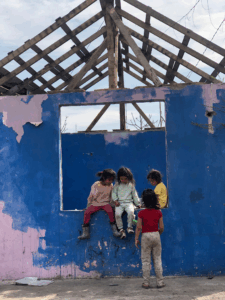
Children’s access to play and sport was severely limited in the earthquake-affected region.
You’ve been active in the earthquake zone. What have you observed, and what role can sport play in post-crisis recovery?
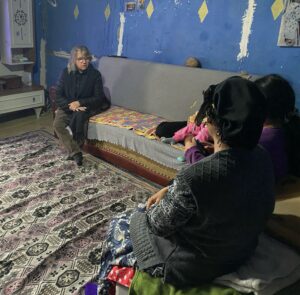
In the earthquake-affected region, access to play and sports for children was already limited before the disaster — and became even more restricted afterwards. Damaged infrastructure, the lack of safe spaces, and the prioritisation of psychosocial needs meant sport was pushed further down the agenda.
Yet, during crises, children need safe spaces where they can express themselves through play and movement, and feel a sense of belonging. Sport is not just a rehabilitation tool — it is a fundamental right. Temporary play areas were set up in partnership with local governments and civil society organisations, but for these initiatives to have lasting impact, long-term strategies are urgently needed.
We aim to develop local solutions to poverty through sport.
Can you tell us about your current project supported by our grant?
This project addresses the urgent issue of child poverty in Türkiye. We aim to strengthen the capacity of local governments through sport — recognising its transformative role in empowerment, child protection, and social development. Our focus is on supporting the rights and development of children living in socio-economically disadvantaged areas.
In partnership with Spor Istanbul, we’re organising awareness-raising trainings and joint meetings to support policy development that enhances children’s participation, safety, and wellbeing in sport. We will also deliver rights-based trainings for sports coaches and interactive activities with children. We hope this model can inspire other municipalities in the future.
When girls say, ‘I can do this too,’ it renews our belief in our work.
How would you describe your impact to those who may want to support your work?
At SAHADAYIZ, we listen to every story we encounter in the field. We see the excitement of children experiencing sport for the first time, the friendships formed on the pitch, and the pride they feel when they push their limits. When girls confidently say, “I can do this too,” it renews our belief in our work.
You can find us rowing on the Bosphorus, playing ball with children, or discussing gender equality with coaches. We are a community that lives sport as a right. Your support is more than a donation — it’s a shared commitment to making these stories possible.